The Hindu Businessline

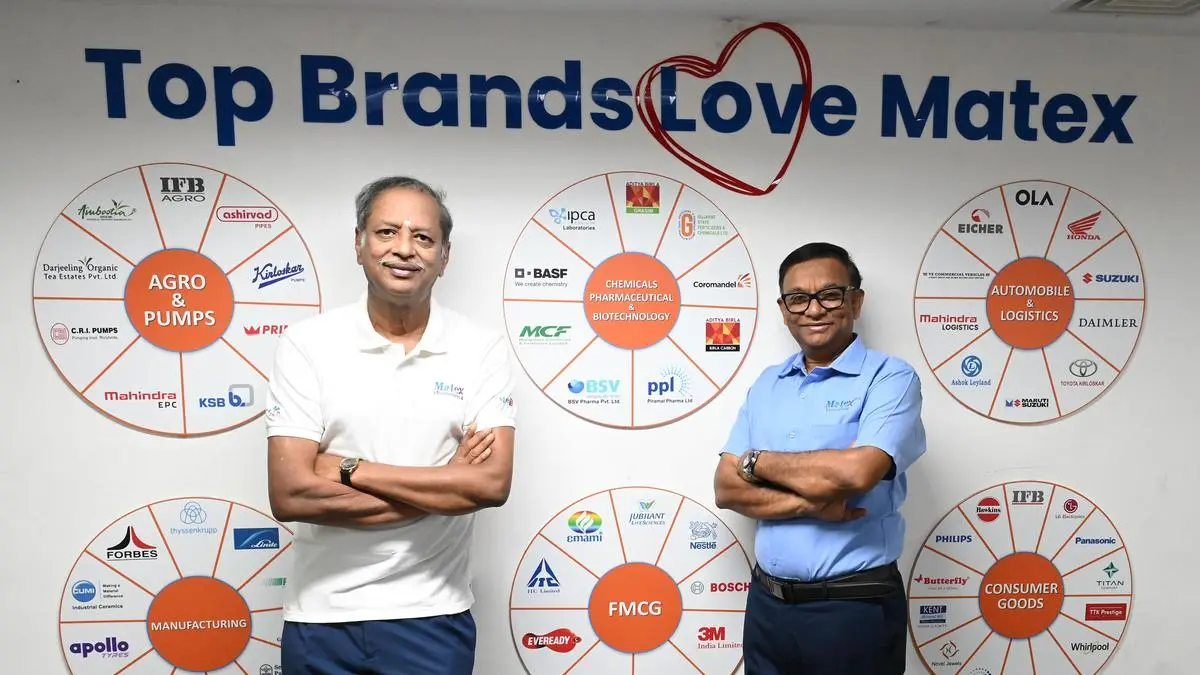
Serving over 800 corporate clients and a network of 20,000 vendors, Matex facilitates auctions for a wide range of products—from small items to entire factories and power plants.

Matex Technologies, the Chennai-based B2B e-auction platform, has nearly doubled the value of auction transactions facilitated on its platform to about ₹8,000 crore annually over the last three years.

Companies use the platform to buy and sell a wide range of products, including scrap.

For instance, when the Standard Motors factory in Chennai was sold to Shriram Properties in 2006, the dismantling and liquidation of the entire plant and machinery were carried out through Matex. More recently, the company facilitated the auction of an entire power plant in India, which was dismantled and transported to Africa for installation.

Extensive client and vendor network
Matex currently serves over 800 corporate clients and works with a network of more than 20,000 qualified and validated vendors across India and neighbouring markets.

The number of active and effective clients increased from 515 in 2023 to 640 in 2026. Matex also launched Proctek and Transportek to handle procurement auctions and transportation negotiations, respectively. The number of active clients on these two platforms has grown from eight to 110.

Driven by these additions and increased client activity, the company’s gross merchandise value (GMV) rose from ₹4,212 crore in 2023 to about ₹8,000 crore currently, he said.

Matex has introduced specialised platforms such as Valuetek, Proctek, Transporttek, Surplustek and Clustertek to help companies with effective price discovery for procurement, logistics, and the sale of surplus materials, finished goods, and scrap.

Seed funding for new ventures
Matex has also seed-capitalised several B2B ventures, including Kuwy, an automotive fintech platform focused on used cars.

The Volkswagen Group holds a majority stake in Kuwy, which facilitates financing of used cars worth over ₹500 crore every month. The platform addresses a used-car fintech market estimated at ₹4 lakh crore, Yogeshwaran said.

Fintech and banking innovation
Matex has also incubated Niyam Tek, a start-up aimed at small banks and NBFCs, offering end-to-end lifecycle digitisation — from early warning signals before an account turns non-performing to the final resolution process.

“At a time when companies are balancing compliance, profitability and growth, Matex platforms simplify complex processes through practical digital solutions and responsible disposal practices aligned with ESG standards,” KE Ranganathan, Director, Matex Technologies, said. “We are now keen to invite strategic partners to bring growth capital and capabilities to accelerate our ambitious growth plans,” he added.
Times Of India

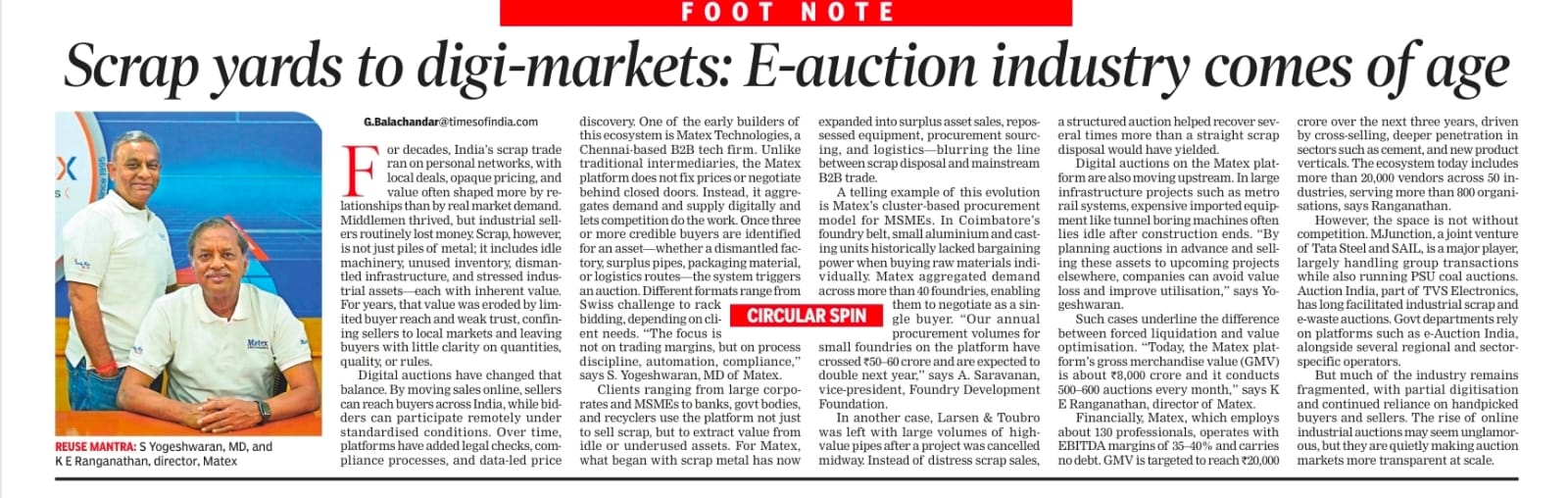
For decades, India’s scrap trade ran on personal networks, with local deals, opaque pricing, and value often shaped more by relationships than by real market demand. Middlemen thrived, but industrial sellers routinely lost money. Scrap, however, is not just piles of metal; it includes idle machinery, unused inventory, dismantled infrastructure, and stressed industrial assets—each with inherent value. For years, that value was eroded by limited buyer reach and weak trust, confining sellers to local markets and leaving buyers with little clarity on quantities, quality, or rules.

Digital auctions have changed that balance. By moving sales online, sellers can reach buyers across India, while bidders can participate remotely under standardised conditions. Over time, platforms have added legal checks, compliance processes, and data-led price discovery. One of the early builders of this ecosystem is Matex Technologies, a Chennai-based B2B tech firm. Unlike traditional intermediaries, the Matex platform does not fix prices or negotiate behind closed doors. Instead, it aggregates demand and supply digitally and lets competition do the work. Once three or more credible buyers are identified for an asset—whether a dismantled factory, surplus pipes, packaging material, or logistics routes—the system triggers an auction. Different formats range from Swiss challenge to rack bidding, depending on client needs. “The focus is not on trading margins, but on process discipline, automation, compliance,” says S. Yogeshwaran, MD of Matex.

Clients ranging from large corporates and MSMEs to banks, govt bodies, and recyclers use the platform not just to sell scrap, but to extract value from idle or underused assets. For Matex, what began with scrap metal has now expanded into surplus asset sales, repossessed equipment, procurement sourcing, and logistics—blurring the line between scrap disposal and mainstream B2B trade.

A telling example of this evolution is Matex’s cluster-based procurement model for MSMEs. In Coimbatore’s foundry belt, small aluminium and casting units historically lacked bargaining power when buying raw materials individually. Matex aggregated demand across more than 40 foundries, enabling them to negotiate as a single buyer. “Our annual procurement volumes for small foundries on the platform have crossed `50–60 crore and are expected to double next year,” says A. Saravanan, vice-president, Foundry Development Foundation.

In another case, Larsen & Toubro was left with large volumes of high-value pipes after a project was cancelled midway. Instead of distress scrap sales, a structured auction helped recover several times more than a straight scrap disposal would have yielded.

Digital auctions on the Matex platform are also moving upstream. In large infrastructure projects such as metro rail systems, expensive imported equipment like tunnel boring machines often lies idle after construction ends. “By planning auctions in advance and selling these assets to upcoming projects elsewhere, companies can avoid value loss and improve utilisation,” says Yogeshwaran.

Such cases underline the difference between forced liquidation and value optimisation. “Today, the Matex platform’s gross merchandise value (GMV) is about `8,000 crore and it conducts 500–600 auctions every month,” says K E Ranganathan, director of Matex.

Financially, Matex, which employs about 130 professionals, operates with EBITDA margins of 35–40% and carries no debt. GMV is targeted to reach `20,000 crore over the next three years, driven by cross-selling, deeper penetration in sectors such as cement, and new product verticals. The ecosystem today includes more than 20,000 vendors across 50 industries, serving more than 800 organisations, says Ranganathan.

However, the space is not without competition. MJunction, a joint venture of Tata Steel and SAIL, is a major player, largely handling group transactions while also running PSU coal auctions. Auction India, part of TVS Electronics, has long facilitated industrial scrap and e-waste auctions. Govt departments rely on platforms such as e-Auction India, alongside several regional and sector-specific operators.

But much of the industry remains fragmented, with partial digitisation and continued reliance on handpicked buyers and sellers. The rise of online industrial auctions may seem unglamorous, but they are quietly making auction markets more transparent at scale.

DT Next

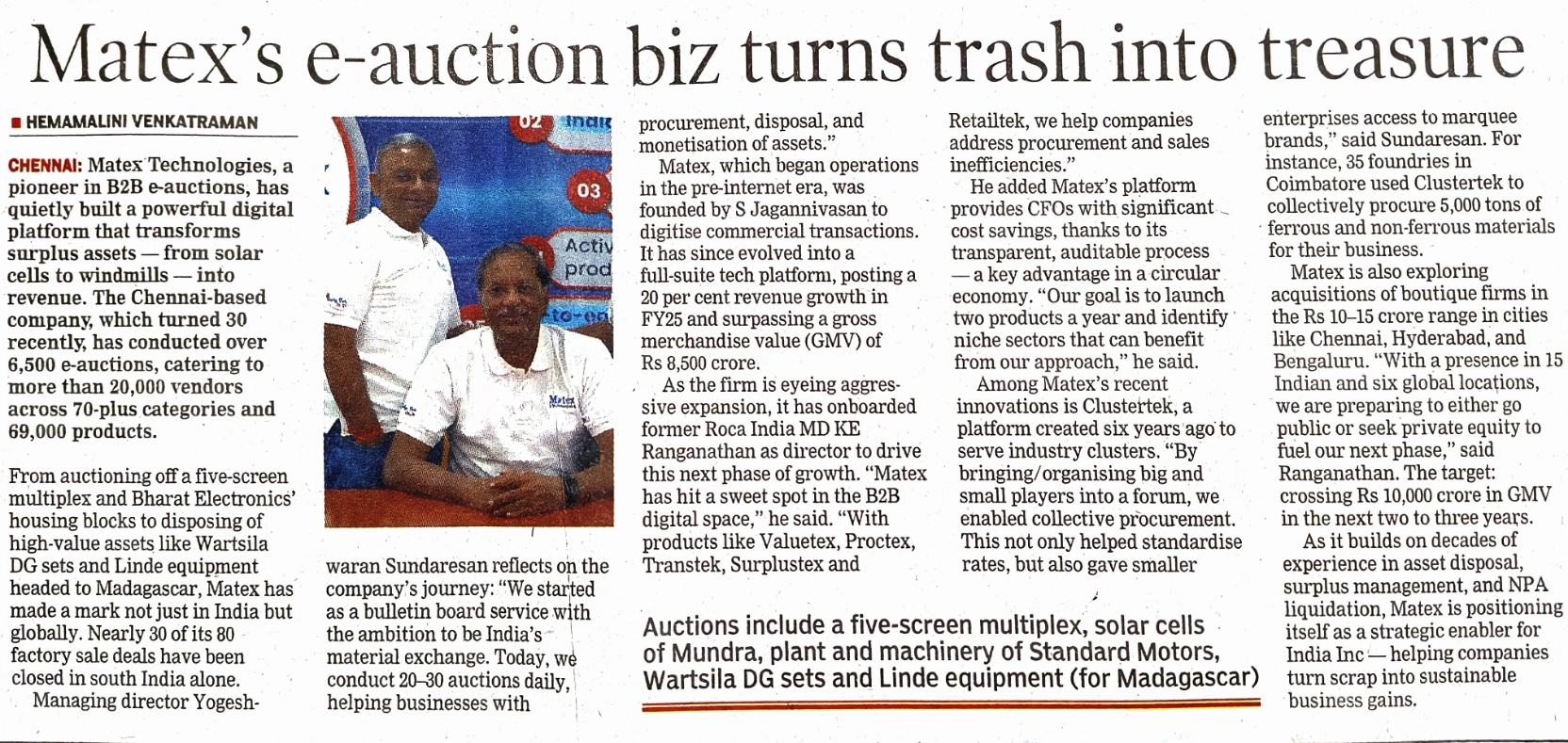
From auctioning off a five-screen multiplex and Bharat Electronics’ housing blocks to disposing of high-value assets like Wartsila DG sets and Linde equipment headed to Madagascar, Matex has made a mark not just in India but globally.

CHENNAI: Matex Technologies, a pioneer in B2B e-auctions, has quietly built a powerful digital platform that transforms surplus assets — from solar cells to windmills — into revenue. The Chennai-based company, which turned 30 recently, has conducted over 6,500 e-auctions yearly, catering to more than 20,000 vendors across 70-plus categories and 69,000products.

From auctioning off a five-screen multiplex and Bharat Electronics’ housing blocks to disposing of high-value assets like Wartsila DG sets and Linde equipment headed to Madagascar, Matex has made a mark not just in India but globally. Nearly 30 of its 80 factory sale deals have been closed in south India alone.

Managing director Yogeshwaran Sundaresan reflects on the company’s journey: “We started as a bulletin board service with the ambition to be India’s material exchange. Today, we conduct 20–30 auctions daily, helping businesses with procurement, disposal, and monetisation of assets.”

Matex, which began operations in the pre-internet era, was founded by S Jagannivasan to digitise commercial transactions. It has since evolved into a full-suite tech platform, posting a 20 per cent revenue growth in FY25 and surpassing a gross merchandise value (GMV) of Rs 8,500 crore.

As the firm is eyeing aggressive expansion, it has onboarded former Roca India MD KE Ranganathan as director to drive this next phase of growth. “Matex has hit a sweet spot in the B2B digital space,” he said. “With products like Valuetek, Proctek, Transtek, Surplustek and Retailtek, we help companies address procurement and sales inefficiencies.”

He added Matex’s platform provides CFOs with significant cost savings, thanks to its transparent, auditable process — a key advantage in a circular economy. “Our goal is to launch two products a year and identify niche sectors that can benefit from our approach,” he said.

Among Matex’s recent innovations is Clustertek, a platform created six years ago to serve industry clusters. “By bringing/organising big and small players into a forum, we enabled collective procurement. This not only helped standardise rates, but also gave smaller enterprises access to marquee brands,” said Sundaresan. For instance, 35 foundries in Coimbatore used Clustertek to collectively procure 5,000 tons of ferrous and non-ferrous materials for their business.

Matex is also exploring acquisitions of boutique firms in the Rs 10–15 crore range in cities like Chennai, Hyderabad, and Bengaluru. “With a presence in 15 Indian and six global locations, we are preparing to either go public or seek private equity to fuel our next phase,” said Ranganathan. The target: crossing Rs 10,000 crore in GMV in the next two to three years.

As it builds on decades of experience in asset disposal, surplus management, and NPA liquidation, Matex is positioning itself as a strategic enabler for India Inc — helping companies turn scrap into sustainable business gains.